References
CASABELLA, juillet-aout 2014, 839-840, p54
|it004|
Balivi Tower
Roberto Rosset
Technical Consultancy
Systems: Studio Pastoret e associati
Structural project: Corrado Cometto
Restoration project: Studio Associati Dalla Costa
Contractors
Zoppoli& Pulcher S.p.A. – Costruzioni Generali - Torino
Client
Regione Autonoma Valle d'Aosta
11100 Aosta,
Italy
The project was elaborated by a team of designers with different skills (architecture, engineering, restoration) in order to adopt organic solutions for a complex intervention that included the philological restoration of the old parts but also the insertion of new distributional and technological elements and the enlargement of parts of the building to accommodate the planned new activities.
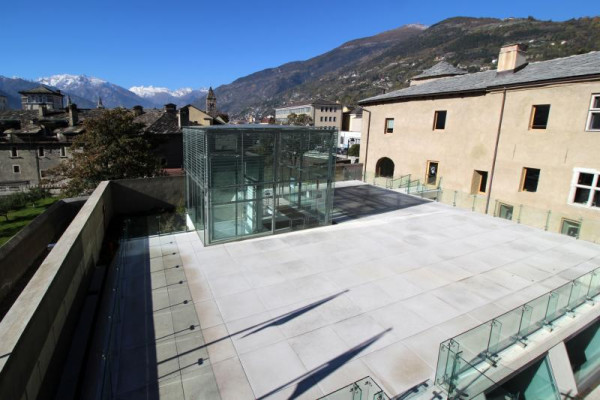
In particular, a new underground volume was built at the inner courtyard to house several classrooms on a first level and an auditorium on the second basement level. The volume, for the visible parts made with a cladding of light-colored stone material, comes out about one meter from the ground level to allow interior lighting thanks to the insertion of side windows.
This creates a new raised terrace, connected through stone piers to the original core, on which a block of structural glass and metal profiles is inserted to house the access stairs inside. The other significant interventions on the existing building involve the creation of the tower's new distribution system.
Original Use Militay
New Use Institutional
Project Date [1999 — 2002]
Build Date [2002 — 2012]
Preexistance
The historic structure, of Roman design, was affected by successive transformations to adapt it to changing uses: from 1192 it was the residence of the De Palatio family, from 1265 to 1626 the seat of the Balivo (representation of the high magistracy), and from 1626 to 1984 a prison.[]
References
CASABELLA, juillet-aout 2014, 839-840, p54