References
Domus, Dec 2015 ,997,p.64
|it003|
Bailo Museum
Studio Mas, Heinz Tesar, Marco Rapposelli , Piero Puggina
Client
Comune di Treviso, Ufficio Lavori Pubblici
Via Camillo Benso conte di Cavour
31057 Silea,
Italy
The project proposes distributional and functional reorganization, consolidation of structures and conservative restoration of the oldest parts, as well as plant upgrading.
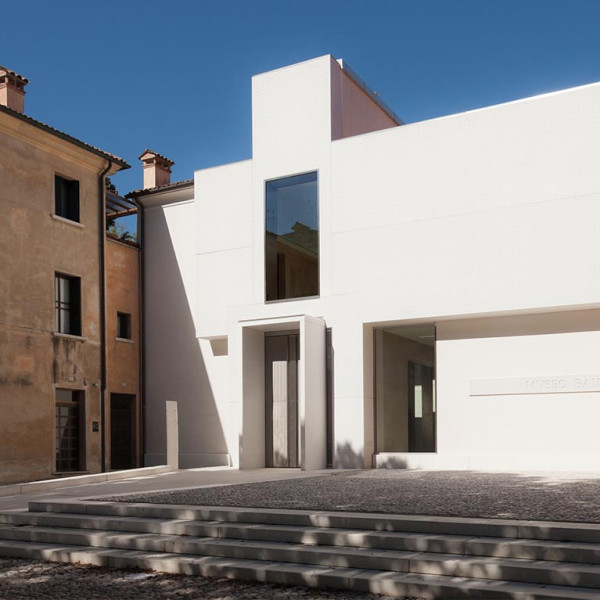
The starting point was the definition of an elevation that would be qualifying for the museum. An artificial stone cladding of Carrara marble grit was chosen, which is similar in color to the white plaster of the old building and, with different surface treatments, also covers the square in front. On the stone facade, a vertical cut introduces the new atrium, which opens into a gallery, about 28m long, carved out of an existing residual space and lit from above. The gallery, made of smoothed concrete, reaches the south cloister and becomes a distributive axis in a structure that has recovered the original spatiality, thanks to the demolition of all non-load-bearing partitions. All wall coverings are in lime, in white marmorino for exteriors.
Original Use Religious
New Use Cultural
Project Date [2010 — 2012]
Build Date [2013 — 2015]
Preexistance
Monastery
[14-16th -century]
[14-16th -century]
References
Domus, Dec 2015 ,997,p.64