|pt019|
Visual Arts Center (CAV)
João Mendes Ribeiro
Collaborators
Manuela Nogueira (on site coordination), Ana Bacelar, Eduardo Mota, Nuno Barbosa, Pedro Grandão, Susana Lobo, Vitor Canas
Technical Consultancy
Foundations and structures: José Carlos Ferreira
Water and sewage installations: Paulo Pereira
Electrical installations and safety: Marcos Pereira Pinguinha
Mechanical installations: Protermia - projectos térmicos industriais e de ambiente, Lda, Eng. Jorge Neves
Stone conservation and restoration: Fernando Marques
History of Art and Archaeology: Institute of History of Art, Faculty of Arts, University of Coimbra, Lurdes Craveiro, Conceição Lopes
Contractors
Teixeira Duarte, Engenharia e Construção, S.A.
Client
Municipal Council of Coimbra
Pátio da Inquisição , 6
3000-221 Coímbra,
Portugal
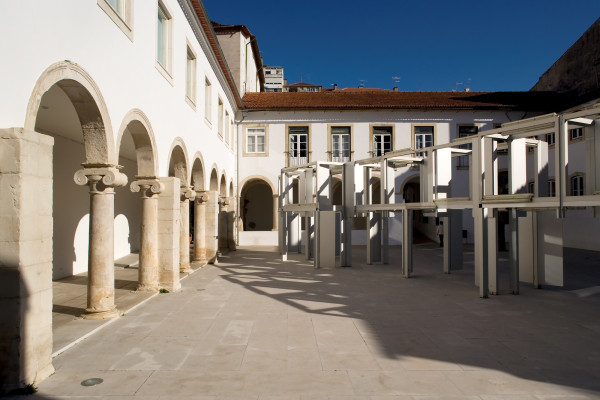
The building's restoration process combines the restoration of the original interior space with the flexible distribution of new uses. Thus, the ground floor, which houses temporary exhibitions, allows for various configurations thanks to rotating panels whose arrangement can free up space or divide it into small enclosures. On this same level, a removable wooden floor protects archaeological remains and provides access to the underground rooms. Stairs made of a metal frame lead to the upper floor, where a load-bearing wall divides the space under the roof into two parts.
Original Use Educational, Military
New Use Cultural
Build Date [1997 — 2003]
Preexistance
College and Prison
[16th century]
[16th century]